 Maze Lodge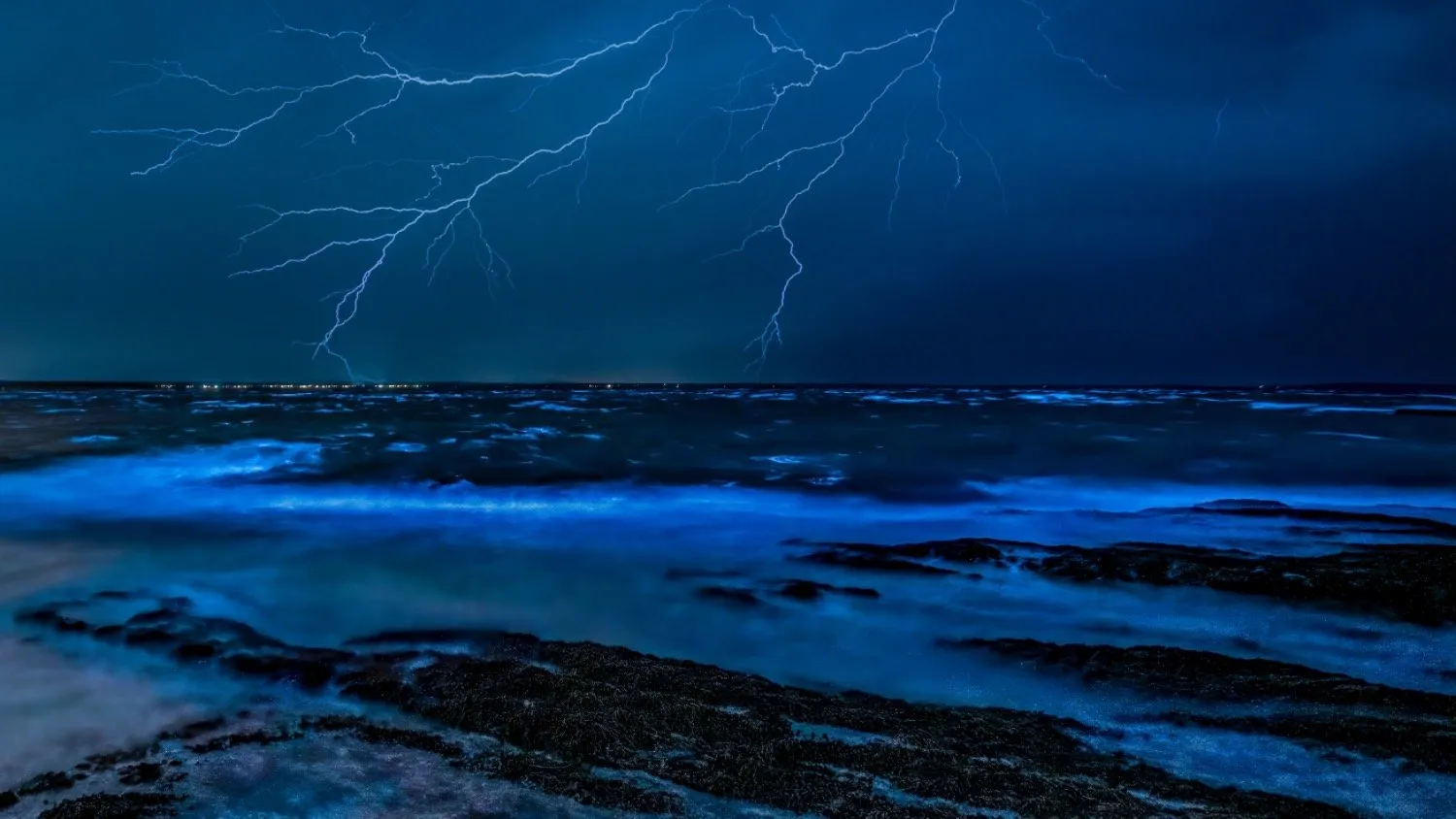
You leave the Puerto Jiménez pier at five in the afternoon, watch the sun go down behind the peninsula, and wait for it to get properly dark. Then someone drags a hand through the water and it lights up — a cold blue-green trail that follows the movement and fades a second later. Fish leave comet tracks. The wake glows. If you get in, your arms glow.
Of everything guests do here, this is the one they talk about years later. Here is how it works, when to come, and what the evening actually involves.
The short answer
- What it is: dinoflagellates — single-celled plankton that flash when the water around them moves.
- When: all year in the Golfo Dulce. The variable that matters is the moon, not the season.
- Best nights: the week around the new moon, when the sky is darkest.
- The trip: out at 5 pm from the Puerto Jiménez pier, roughly three hours, $95 per person — our bioluminescence tour.
- Bring: swimwear and a towel. Yes, you can swim in it.
What is actually happening
The glow comes from dinoflagellates, microscopic plankton drifting in the gulf in enormous numbers. When the water around one is disturbed — by a wave, a paddle, a fish, your hand — it fires off a brief chemical flash. One is invisible. Billions of them turn every movement into light.
Why here, so reliably? The Golfo Dulce is a tropical fjord: deep, sheltered, warm, fed by rivers and mangroves, and unusually still. That combination keeps plankton concentrated and the surface calm enough for you to see the effect. The same geography is why humpback whales use the gulf as a nursery.
The flash is a defence: it startles what is eating them, and it attracts bigger predators to the thing that is eating them. You are, in effect, floating in an alarm system.
When to go — the moon matters more than the month
The plankton are there all year. What changes is how much competing light there is.
- New moon, and the three or four nights either side: the best conditions. Dark sky, dark water, maximum contrast.
- Half moon: still very good once the moon sets or before it rises — timing is everything, and local captains know it.
- Full moon: the weakest. The glow is still there; you just cannot see it well against a lit-up sea.
- Season: a secondary factor. Rain and river flow can affect clarity, and a flat, windless night is better than a choppy one. In the green season the afternoon storms usually clear before dusk.
Practical advice: pick your night before you book the rest of the week. We look at the moon calendar for your stay and tell you which evening to keep free.
What the evening is like
Josh runs the 5 pm trip, and the timing is deliberate: you go out in daylight, so the first hour is the gulf at golden hour — pelicans, frigatebirds, the forest going orange, the mountains behind Golfito turning purple. Then the sun drops, and you wait in the dark for your eyes to adjust.
The glow starts subtly. A hand in the water. Then the boat turns and you see the wake burning behind you. Fish become visible as streaks under the surface — you can watch a shoal scatter as a shape of light. And then you get in, if you want to, and every movement you make is drawn in blue.
Back at the pier under a sky that, on a new-moon night this far from any city, is doing its own performance. Three hours, start to finish, and you are on the terrace by nine.
Honest expectations
- Your phone will not capture it. Not one bit of it. Modern phones are astonishing in low light and still hopeless at this — the flashes are too brief and too dim. Bring your eyes, not a camera, and accept that this one lives in memory.
- It varies night to night. Plankton concentration moves with tide, wind and rain. Most nights are good; occasionally a night is extraordinary; rarely, it is faint.
- It is not neon. Think of a cold blue-green spark, closer to embers than to a light show. The internet is full of enhanced photographs that promise something else.
- It is completely harmless to swim in.
Practical notes
- Swimwear under your clothes, a towel, and a dry layer for the ride back — you get cool once the sun is gone and you are wet.
- No white torches on the boat once it is dark; they ruin everyone's night vision, including yours.
- Bring a jumper for the wind and repellent for the pier.
- Children love it and manage the three hours well.
- Combine it with a slow day: pool, hammock, river walk in the day, glowing water at night. Do not do it the evening before a 4 am Corcovado start.
Frequently asked questions
What causes bioluminescence in the Golfo Dulce?
Dinoflagellates — single-celled plankton that emit a brief flash of light when the water around them is disturbed. In large concentrations, every movement lights up.
What is the best time of year for bioluminescence in Costa Rica?
In the Golfo Dulce it runs all year. The moon phase matters far more than the month: aim for the week around the new moon.
Can you swim in bioluminescence?
Yes, and it is the best part. It is harmless, and swimming is when the effect stops being something you are watching and becomes something you are inside.
How much does the bioluminescence tour cost?
$95 per person for around three hours, leaving the Puerto Jiménez pier at 5 pm.
Can you photograph bioluminescence?
Realistically, no — not with a phone, and only with difficulty with a fast lens, a tripod and a lot of patience. Plan to remember it rather than record it.
Is it guaranteed?
No. It is a natural phenomenon and it varies. Booking around the new moon and a calm night gives you the best odds by a wide margin.
Where else can you see it in Costa Rica?
Parts of the Nicoya Peninsula and some mangrove estuaries have it, but few places combine dark skies, sheltered water and reliable concentrations the way this gulf does.
Where to be that night
The boat leaves from the pier, ten minutes from Maze Lodge — four private lodges from $110 a night, 5.8 km outside Puerto Jiménez, on the corridor between Corcovado and the Tranquility reserve. We get you to the pier and back, and we will look at the moon calendar for your dates and tell you which night to book.
Come back late, sit on the terrace, and listen to the forest do the night shift. It is a good way to end a day.
Read it from the terrace.
Four private lodges from $110 a night.