 Maze Lodge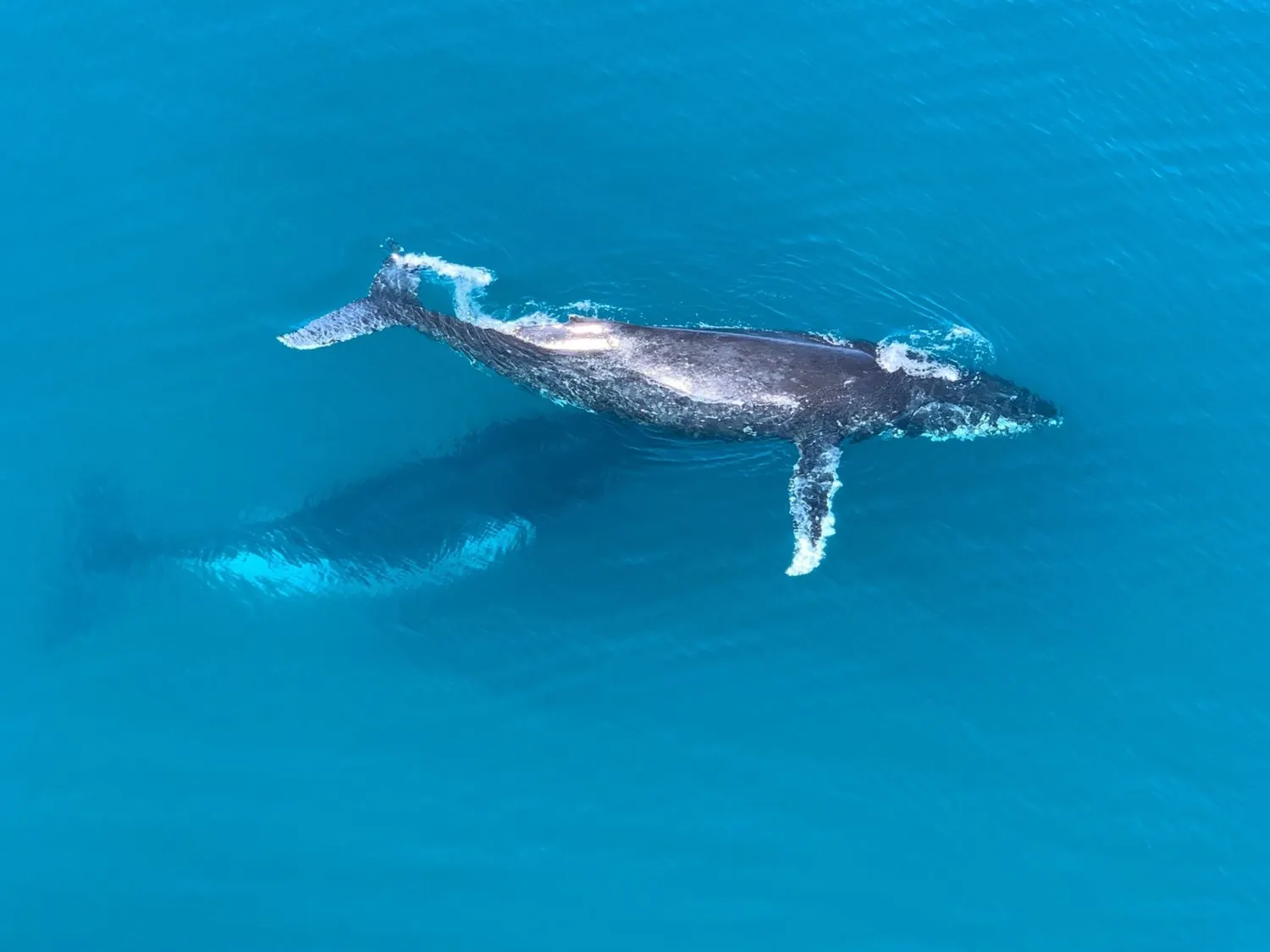
There are four tropical fjords on Earth, and one of them is ten minutes from our gate. The Golfo Dulce is deep — over 200 metres in places — narrow-mouthed, ringed by rainforest, and unusually calm. Humpback whales have worked this out. They come here to give birth and raise calves, from two hemispheres, at two different times of year, which makes this one of the few places on the planet where whale season runs for roughly eight months.
This is the guide to when to come, what a morning on the water actually involves, and what you will see besides whales.
The short answer
- Southern humpbacks: roughly July to November, peaking August to October. The bigger, more reliable season — these whales come up from the waters off South America.
- Northern humpbacks: roughly December to March, fewer in number, arriving from the north Pacific.
- Dolphins: resident all year, bottlenose and pantropical spotted.
- Boats: leave the Puerto Jiménez pier around 8.30 am, four hours, $90 per person on our Golfo Dulce boat and snorkel tour.
- Why here rather than the open coast: the gulf is sheltered. Boat mornings are calm here on days when the Pacific is unusable.
Why the Golfo Dulce
A fjord in the tropics is a strange thing: a deep basin scoured out and then half-closed by a shallow sill at the mouth. That geography gives the gulf warm, still, protected water — exactly what a newborn calf needs while it learns to breathe, swim and put on the fat it will need for the migration back.
Mothers bring calves into the shallow edges near the mangroves and stay for weeks. You are not chasing a whale across open ocean here; you are visiting a nursery. It is a quieter, closer, slower kind of whale watching than the sort you may have done in Iceland or California, and the calves are frequently curious.
The same water holds dolphins year round, olive ridley and green turtles, rays, and — if the day is generous — tuna working the surface with frigatebirds overhead.
Month by month
July
The first southern humpbacks arrive. Numbers build through the month. Fewer boats out, and a good chance of having a sighting to yourself.
August
Season proper. Mothers with newborn calves in the sheltered water. If we had to book one month for whales, this would be it — the gulf is calm, the forest is green, and the peninsula is not yet busy.
September
Peak activity, and peak rain. Mornings are usually clear and the afternoons belong to the storms, so the 8.30 am departure is exactly right. Also peak turtle nesting season on the Pacific beaches.
October
Whales still here, the wettest month on the peninsula, the quietest of the year for visitors. Sirena station in Corcovado closes for maintenance in October, so this is a month for the water rather than the park.
November
The southern season tails off through the month while the weather improves. A good transitional month with the gulf largely to yourself.
December to March
The northern population arrives — fewer animals, but this is also the dry season, so you get flat water, blue skies and the best all-round conditions of the year. Sightings are less certain than in August to October; everything else about the trip is easier.
April to June
The quiet stretch. Dolphins, turtles and the coastline are still there, and the boat still runs — but do not book a trip around whales in May.
What a morning on the gulf is like
You meet at the Puerto Jiménez pier around 8.30 am — ten minutes from the lodge, and we get you there. Josh has run these waters for twenty years, which mostly means he knows where the whales were yesterday and where the water will be flat today.
The boat is small, which is the point: departures are flexible and based on demand, so you are not on a hundred-seat catamaran with a public address system. You spend the first stretch heading up the gulf, scanning. When a blow is spotted, the engine comes down and you wait — the animals decide how close this gets, not the boat.
The rest of the four hours is coastline: Piedras Blancas National Park on the far shore, which has no road access at all, snorkelling over the reefs when conditions allow, dolphins that come to ride the bow, and the peninsula seen the way it should be, as a wall of green coming down to the water.
Back at the pier by lunchtime, in time for a siesta before the afternoon rain.
Watching whales without harming them
The Golfo Dulce is a recognised whale heritage area, and the rules exist because whale watching done badly is genuinely damaging — separated calves, disrupted feeding, engine noise in a nursery.
- Distance is kept, always. Boats approach slowly, from the side and slightly behind, never head-on and never between a mother and calf.
- Engines idle or off near animals, and no boat should stay with one group for long.
- Nobody swims with the whales. If an operator offers it, that tells you what you need to know about them.
- Small boats, few of them. Ask how many boats an operator puts on the water at once.
We book with local captains who follow this. It is also, incidentally, how you get the better experience: a calm boat sitting still is what makes a curious calf come to look at you.
Practical notes
- Book the morning slot. The water is flattest before ten, and in the green season the rain comes later.
- Bring: sunscreen, a hat, a light layer for the wind, water, swimwear and a towel for the snorkelling stop, and a dry bag for the camera.
- Seasickness: rarely an issue in the gulf, but if you are prone to it, take something an hour before and sit mid-boat looking at the horizon.
- Cameras: a phone will get you a memory, not a photo. If you have a zoom lens, this is its day.
- Sightings are never guaranteed. In the August to October window they are close to routine; in April, they are not.
Frequently asked questions
When is whale season in Costa Rica's Golfo Dulce?
Two seasons: southern-hemisphere humpbacks roughly July to November, peaking August to October, and northern-hemisphere humpbacks roughly December to March. That is around eight months of the year with whales in the gulf.
What is the best month for whale watching on the Osa Peninsula?
August, September or October for the number of animals; December to March for the weather and calm seas.
How much does a whale watching tour cost?
Our Golfo Dulce boat and snorkel tour is $90 per person for around four hours, with a minimum of $350 for groups of fewer than four.
Are you guaranteed to see whales?
No, and be suspicious of anyone who guarantees it. In peak season sightings are very common; dolphins are near-certain year round.
Is the Golfo Dulce better than Uvita or Marino Ballena for whales?
Marino Ballena is more famous and more crowded. The gulf is calmer, quieter and closer to a calving nursery, and you will usually share a sighting with one boat rather than six. If you are already on the Osa, there is no reason to drive north.
Can children come on the boat?
Yes. It is a four-hour trip on sheltered water; families do it regularly. Bring sun protection and snacks.
What else will we see?
Dolphins, sea turtles, rays, frigatebirds, pelicans, the coastline of Piedras Blancas National Park, and reef fish at the snorkelling stop. More on all of it in our Osa wildlife guide.
Where to stay for it
The boats leave from the Puerto Jiménez pier, ten minutes from Maze Lodge. We are four private lodges from $110 a night on the corridor between Corcovado and the Tranquility reserve — whales in the morning, howler monkeys at dawn, and the gulf glowing at night if you also book the bioluminescence trip.
Tell us your dates and we will tell you honestly what the whales have been doing that week.
Read it from the terrace.
Four private lodges from $110 a night.