 Maze Lodge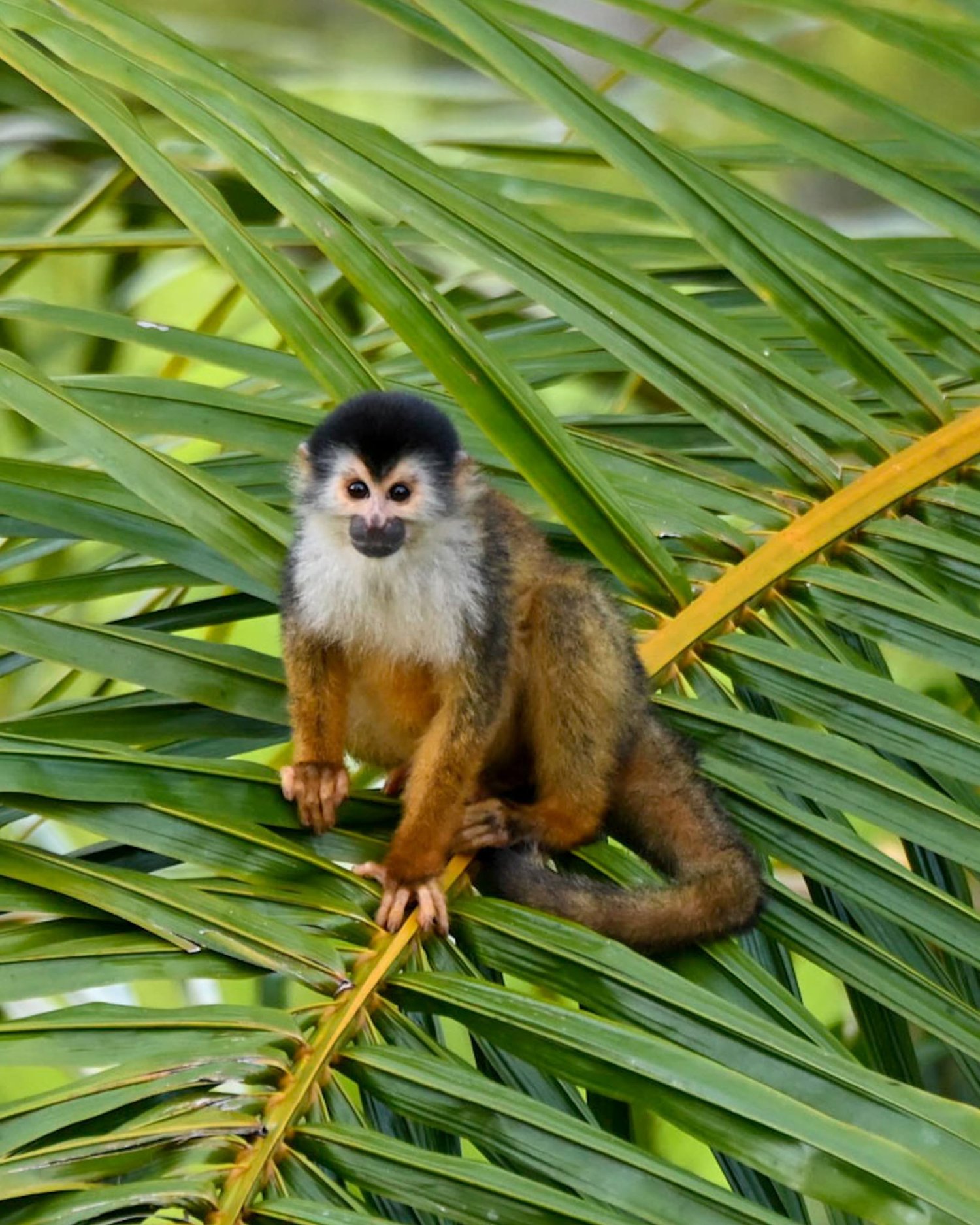
National Geographic called the Osa Peninsula “the most biologically intense place on Earth”, and the number behind the phrase is genuinely hard to believe: roughly 2.5% of the planet's biodiversity on about 0.001% of its surface. Four monkey species. Five of Costa Rica's six wild cats. Over 460 species of bird. Ten thousand species of insect, give or take the ones nobody has named yet.
What that means in practice is less obvious than the statistics suggest. You will not see everything. You will see a great deal more than you expect, and most of it in places you did not plan to be — from a terrace, on a gravel road, above a football pitch at five in the afternoon. This is the guide to what actually lives here, where each animal is realistically found, and how to see more of it.
How to actually see wildlife here
Almost everything about your sightings comes down to five things, and none of them is luck.
- Be out at dawn. Between 5.30 and 8.30 the forest does most of its business. By eleven, activity collapses; it picks up again from four.
- Go with a guide at least once. A naturalist with a telescope finds ten times what you find alone, and — more usefully — teaches you what to look for. Guests who take a night walk on their first evening see noticeably more for the rest of their stay.
- Stand still and be quiet. Most people walk past animals. Twenty steps, stop, listen for two minutes. Rustle above you is usually monkeys; a dropped fruit is a giveaway.
- Work the edges. Forest edges, river banks, fruiting trees and clearings hold far more visible life than deep, uniform forest.
- Look up, then look down. Monkeys, birds and sloths are above; frogs, snakes, agoutis and the best insects are at your feet.
Monkeys — all four species
Costa Rica has four monkey species and the Osa has all of them, which is not true of most of the country.
Mantled howler
The alarm clock. Black, heavy-set, and responsible for the roaring that starts around 5.40 am and carries for kilometres. Common in the canopy along rivers and roads; you will hear them daily whether or not you see them.
White-faced capuchin
Clever, curious and completely unbothered by people, which is exactly the problem — they will open a bag, a cool box or an unlatched door. Watch them, do not feed them, and keep the terrace doors closed while you swim.
Central American squirrel monkey
Small, orange-backed, endangered, and found only in a narrow strip of the Pacific south and Panama. The Osa holds one of the largest remaining populations. They travel in troops of twenty to fifty and arrive like weather — a wave of movement through the canopy, and then gone.
Geoffroy's spider monkey
The acrobat: all limbs and prehensile tail, high in mature forest, and the species most dependent on undisturbed canopy — which is why seeing them is a good sign about the forest you are standing in. Best odds inside Corcovado and in the older forest of the corridor.
The cats — five of six
Jaguar, puma, ocelot, margay and jaguarundi all live on the peninsula. Corcovado is one of the last strongholds of the jaguar in Central America.
You will almost certainly not see one, and any guide who promises otherwise is selling something. What you can realistically find is evidence: tracks in the mud on a morning trail, scratch marks, a camera-trap image from a neighbouring property. Ocelot and jaguarundi are the two most often glimpsed, usually crossing a road at dusk or dawn. Treat any cat sighting as the luck of a decade.
The large mammals worth planning around
- Baird's tapir. The largest land mammal in Central America, endangered, and startlingly common around Sirena station in Corcovado — where individuals sleep in the mud near the buildings and ignore visitors entirely. This is the single best reason to make Sirena the entrance you fight for.
- White-lipped peccary. Herds of dozens, loud, smelly and genuinely impressive to meet. Mostly deep inside the park. Your guide will know how to position you.
- Northern tamandua. The tree anteater — mostly nocturnal, occasionally on a path at dusk, ripping open a termite nest with claws like a builder's tool.
- Sloths. Both the two-toed and three-toed species. Look for a grey lump in a cecropia that has moved since yesterday.
- Coati, agouti, kinkajou, olingo. Coatis in daylight, often in family parties; agoutis on the forest floor; kinkajous and olingos at night in the fruiting trees, which is why night walks turn up mammals that day walks never do.
Birds — 460 species, and a few you will remember
- Scarlet macaw. The Osa has one of the largest populations in Central America. They mate for life, fly in pairs, feed in beach almond trees, and are entirely unmissable — in town, over the road, across our hill every evening.
- Yellow-throated toucan. Enormous bill, call like a squeaky gate. Regular in fruiting trees at breakfast height.
- Fiery-billed aracari. The small toucan with the flame-coloured beak, effectively restricted to the Pacific south of Costa Rica and western Panama — a genuine speciality of this coast.
- Hummingbirds. Several species, all impossibly fast, all at the flowering shrubs by any terrace.
- Trogons, motmots, tanagers, honeycreepers, manakins, woodpeckers. The everyday cast, and the reason birders book two weeks rather than three days.
- Harpy eagle. The legend. Historic records exist for the peninsula and reports surface occasionally; realistically, do not plan around it.
- Seabirds and shorebirds. Frigatebirds, pelicans, ospreys, herons and ibis along the gulf and in the mangroves.
In the water
- Humpback whales. The Golfo Dulce is one of very few places on Earth visited by humpbacks from both hemispheres — the southern population roughly July to November, the northern one roughly December to March. They come here to give birth and raise calves in sheltered water, which is why the boat tour runs successfully in months when the open Pacific is unusable.
- Dolphins. Bottlenose and pantropical spotted dolphins are resident year round.
- Sea turtles. Olive ridleys nest on the peninsula's Pacific beaches, mainly July to December with a peak from September to November. Green and hawksbill turtles are seen in the gulf.
- Bull sharks. In the river mouth at Sirena, visible from the bank, entirely uninterested in the bank.
- Bioluminescent plankton. Not wildlife you watch so much as wildlife you swim inside. Best around the new moon; details on the bioluminescence tour.
Frogs, snakes and the small things
The Osa's amphibians are a large part of why night walks are so good here. Red-eyed tree frogs are the poster animal; glass frogs, whose organs are visible through their skin, sit on leaves above streams; and the Golfo Dulce poison frog is a regional speciality found in this corner of Costa Rica and almost nowhere else.
On snakes: yes, there are venomous species — the terciopelo (fer-de-lance) and the eyelash viper are the two to know, along with harmless boas and a long list of others. In years of guests walking these trails, the practical rules have never changed: wear closed shoes, carry a torch after dark, look where you put your hands and feet, and do not attempt to move a snake. Bites are rare and almost always the result of someone touching one.
And the invertebrates deserve better press than they get: blue morpho butterflies flashing along the river, leafcutter ant highways that reroute overnight, orchid bees like flying jewels, and scorpions that glow an unearthly blue under a UV torch — which is the single most reliable party trick on any night walk.
Where to see what
- From a terrace: toucans, aracaris, hummingbirds, howlers, capuchins, squirrel monkeys, macaws overhead at dusk, sloths if you are patient.
- On night trails: frogs, snakes, scorpions, kinkajous, opossums, owls, insects that do not look real.
- Inside Corcovado: tapirs, peccaries, spider monkeys, agoutis, caimans, macaws in numbers, the whole large-mammal cast. See the Corcovado guide.
- On the Golfo Dulce: whales, dolphins, turtles, rays, frigatebirds.
- In the mangroves: herons, ibis, kingfishers, crocodiles, crabs.
- On the beaches: macaws in the almond trees, hermit crabs, nesting turtles in season, vultures doing the clean-up.
- On a private river trail: everything above in miniature, with a guide who has all morning — our river walk covers the corridor between the park and the reserve.
Watching wildlife without wrecking it
- Never feed anything. Fed capuchins become aggressive and fed coatis stop foraging. It is the fastest way to ruin an animal.
- Keep your distance and let them move first. If an animal changes its behaviour because of you, you are too close.
- Go easy with light at night. No flash at nocturnal animals; keep torches off their eyes.
- Stay on trails and take a certified guide in the park — required in Corcovado, and better everywhere else.
- Close your doors. Capuchins have hands and no manners.
Frequently asked questions
What animals live on the Osa Peninsula?
Around 140 mammal species, 460-plus birds, and thousands of amphibians, reptiles and insects — including all four Costa Rican monkey species, five of the country's six wild cats, Baird's tapir, scarlet macaws, sloths, anteaters, and humpback whales in the gulf.
What is the best place to see wildlife on the Osa?
Corcovado National Park for large mammals, the Golfo Dulce for marine life, and any patch of good forest at dawn for everything else. The corridor between Corcovado and the Tranquility reserve — where we are — is used by animals crossing between the two, which is why so much of it turns up around the lodges.
What is the best time of year for wildlife on the Osa Peninsula?
All year. The dry season, December to April, concentrates animals near water and makes trails easier; the green season brings whales, turtles, frogs and nesting birds. Full detail in our month-by-month guide.
Are there dangerous animals on the Osa Peninsula?
There are venomous snakes, crocodiles in the estuaries and, in theory, big cats. Incidents involving visitors are very rare. Closed shoes, a torch at night, a guide in the park, and not touching things covers essentially all of the risk.
Can you see monkeys from the lodge?
Yes — howlers and capuchins near daily, squirrel monkeys in troops, spider monkeys higher up. We built four small lodges inside existing forest rather than clearing it, which is the reason the animals still come through.
Do I need binoculars?
Bring them if you own them. Guides carry telescopes on tours, which are better for the far-off things, but binoculars change what you notice from your own terrace with a coffee.
Stay inside the corridor
Maze Lodge sits between Corcovado National Park and the Tranquility Wildlife Reserve, 5.8 km from Puerto Jiménez. Four private lodges from $110 a night, built into the primary forest, solar-powered, each with a terrace where a great deal of this list turns up on its own. When you want more than the terrace, we book the guides — river walks, night walks, Corcovado and the gulf.
Every photo on our wildlife page was taken here or within a short drive. Sightings are never guaranteed. That, as we tell everyone, is rather the point.
Read it from the terrace.
Four private lodges from $110 a night.