 Maze Lodge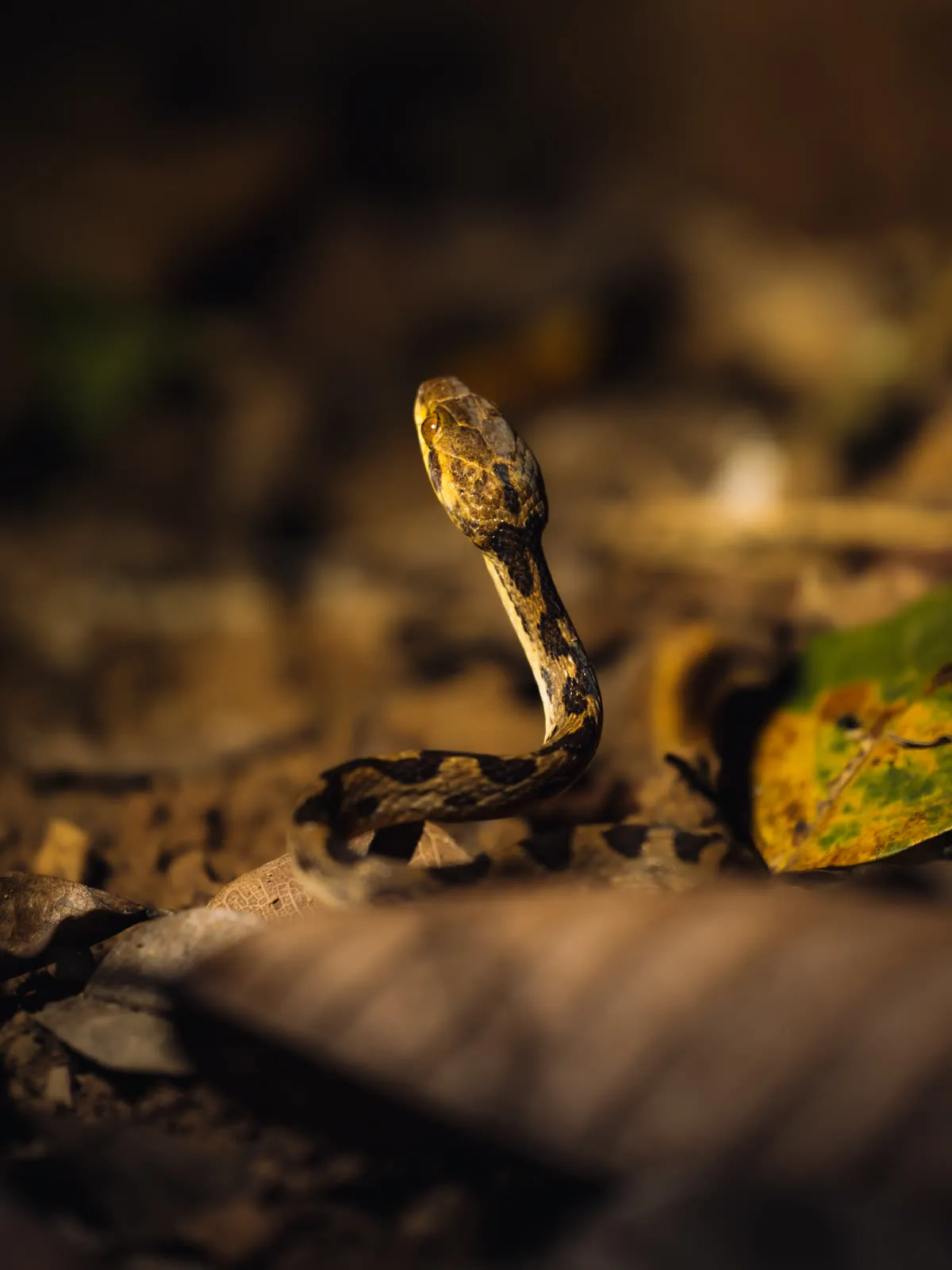
Somewhere between booking and boarding, most visitors to a rainforest have a quiet moment of doubt about snakes. It is a reasonable thing to think about and a poor thing to worry about, and the gap between those two is what this guide is for.
We live in this forest. Here is the calm version.
The short answer
- Yes, there are venomous snakes here. Two matter in practice: the terciopelo (fer-de-lance) and the eyelash viper.
- Bites are rare, and almost always the result of someone touching, grabbing or stepping directly onto a snake.
- Four habits cover nearly all the risk: closed shoes, a torch after dark, look before you put a hand or foot somewhere, and never touch a snake.
- Costa Rica handles snakebite well. Antivenom is produced domestically and hospitals are equipped for it.
- Most snakes you see will be harmless, and seeing one at all is a good day for a naturalist.
The two that matter
Terciopelo (fer-de-lance)
The one to know. A heavy-bodied pit viper, brown and grey with a pattern of dark triangles, that lies still on the forest floor and relies entirely on camouflage. It is responsible for the large majority of serious snakebites in Central America, not because it is aggressive but because it is common, well hidden and does not move when you approach.
Which is exactly why the rule is: watch where you put your feet, and stay on the trail. A snake you can see is not a problem.
Eyelash viper
Small, coiled on branches and leaves at head height, and often a startling yellow — the scales above the eyes give it its name. Beautiful, photogenic, and the reason you do not grab vegetation to steady yourself. It sits still and waits; nearly all bites come from a hand landing on one.
The others
Coral snakes exist here and are highly venomous, but they are secretive, small-mouthed and bites are very rare. Boa constrictors are non-venomous and impressive. The bulk of what you will see — vine snakes, cat-eyed snakes, blunt-headed snakes — is harmless.
How bites actually happen
Look at any set of case notes and the same pattern appears:
- Someone tried to move, catch, kill or photograph a snake at close range.
- Someone put a hand on a branch, rock or log without looking.
- Someone walked off-trail at night in sandals.
- Someone was working in agriculture, barefoot or in wellies, which is who the majority of Costa Rican bites actually happen to — not tourists.
Notice that visitors on guided trails in shoes barely appear on that list.
The four habits
- Closed shoes on trails. Always. Sandals are for the pool and the terrace.
- A torch after dark, pointed at the ground ahead of you. Most snakes here are nocturnal; this single habit removes most of the remaining risk.
- Look before you place a hand or a foot. Do not reach into vegetation, do not grab branches blind, do not sit on a log without checking it.
- Never touch a snake, alive or apparently dead. Not to move it, not for a photo, not to prove anything.
Add a fifth if you like: stay on the trail, and take a guide the first time. A naturalist will find snakes you would have walked straight past, and will position you at a sensible distance while you look at them.
If someone is bitten
Very unlikely, but the plan is worth knowing:
- Move away from the snake and keep everyone calm. Panic raises heart rate, which is genuinely unhelpful.
- Keep the bitten limb still and below heart level. Remove rings and watches before swelling starts.
- Get to hospital. That is the treatment. Costa Rica produces its own antivenom and the emergency number is 911; from the lodge, tell us and we will drive.
- Do not apply a tourniquet, cut the wound, try to suck out venom, apply ice, or give alcohol. All of these make outcomes worse.
- Photograph the snake only if it is safe and effortless. Identification helps but is not required; treatment is largely the same for the vipers here.
The other things people ask about
- Scorpions: present, and their sting hurts like a bad wasp sting. Shake out shoes and clothing. Not dangerous to healthy adults.
- Spiders: tarantulas are common, slow and harmless to you. Nothing here is a meaningful medical threat.
- Crocodiles: in the estuaries and river mouths. Do not swim there. The pool and the sea off the beaches are fine.
- Big cats: five species live on the peninsula and they want nothing whatever to do with you.
- Mosquitoes and sandflies: statistically far more relevant to your holiday than any snake. Repellent, and cover up at dawn and dusk.
- The actual biggest risks on the Osa are sunburn, dehydration, the roads, and the sea. In that order.
Why we would rather you saw one
An eyelash viper coiled on a heliconia leaf is one of the most beautiful things in this forest. A terciopelo, seen safely from three metres with a guide explaining how the camouflage works, is the moment many guests describe afterwards as the point where the rainforest stopped being scenery and became real.
The night walk is where you are most likely to meet one, in the safest possible circumstances: a guide in front, torches, closed shoes, and a marked trail. Fear here is almost entirely a function of not knowing what you are looking at.
Frequently asked questions
Are there venomous snakes in Costa Rica's rainforest?
Yes. Around a fifth of Costa Rica's snake species are venomous; the terciopelo (fer-de-lance) and the eyelash viper are the two that account for most incidents.
How likely is a snakebite as a tourist?
Very unlikely. Bites overwhelmingly affect agricultural workers, and visitor bites almost always involve someone handling a snake. Guided visitors in closed shoes are at very low risk.
What should I do if I see a snake?
Stop, step back, and leave it alone. Tell your guide. Do not attempt to move it or photograph it up close.
Is there antivenom in Costa Rica?
Yes — Costa Rica produces its own and is a regional centre for it. Hospitals treat snakebite routinely. Emergency number: 911.
Do I need snake boots or gaiters?
No. Ordinary closed walking shoes and long trousers are what guides here wear every day.
Are the lodges safe?
Yes. Snakes have no interest in buildings. Keep doors closed at night, shake out your shoes, and carry a torch on the paths after dark — the same habits everyone here uses without thinking about it.
Come and be shown
Maze Lodge sits inside primary forest on a wildlife corridor, and our guides walk these trails nightly. Four private lodges from $110 a night, spare torches in the cupboard, and the full cast list of what else lives out there.
Read it from the terrace.
Four private lodges from $110 a night.