 Maze Lodge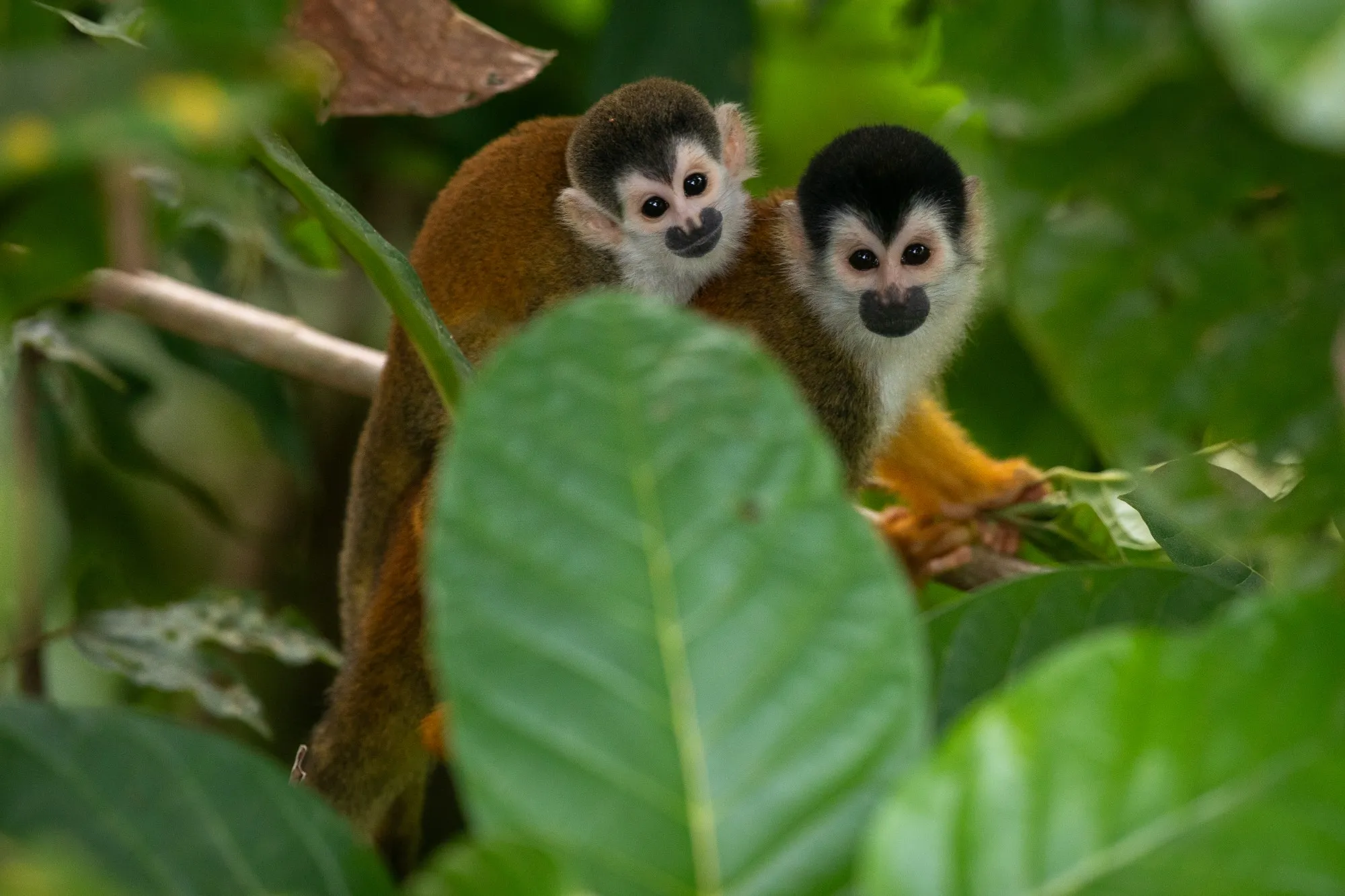
Costa Rica has four monkey species. Most of the country has two or three. The Osa Peninsula has all four, in numbers, on the same hillsides — which is why serious wildlife travellers end up down here even though it is the hardest part of the country to reach.
Here is how to tell them apart, what each one is actually doing when you see it, and how to line up a morning that finds all four.
The four, at a glance
- Mantled howler — black, heavy, slow, deafening at dawn. The one you hear.
- White-faced capuchin — medium, cream face, clever, bold. The one that opens your bag.
- Central American squirrel monkey — small, orange-backed, endangered, travels in big troops. The one that arrives like weather.
- Geoffroy's spider monkey — long-limbed, high in mature forest, prehensile tail. The one that means the forest is intact.
Mantled howler
Recognise it by: a heavy black body in the canopy, moving deliberately, often sitting still for long stretches. And the noise — a roar that sounds far larger than the animal producing it, carrying several kilometres.
The roaring starts around 5.40 am and again at dusk, and is territorial: troops announce their position to each other rather than fight over it. Howlers eat mostly leaves, which is a low-energy diet, which is why they spend most of the day doing nothing at all. They are the easiest of the four to find and the least entertaining to watch, and you will hear them every single morning of your stay.
White-faced capuchin
Recognise it by: the cream face and shoulders against a black body, constant movement, and an unmistakable air of being up to something.
Capuchins are the problem-solvers: they open things, test things, and learn fast. That intelligence makes them the species most likely to approach people, and the one where the rules matter most. Do not feed them — a fed capuchin becomes bold, then aggressive, then a problem that gets solved badly. Keep terrace doors closed while you are at the pool, and do not leave a bag unattended on a beach.
Watched from a sensible distance, they are the best entertainment in the forest. A troop working through fruiting trees will hold your attention for an hour.
Central American squirrel monkey
Recognise it by: small size, orange-brown back, pale face with a dark cap, and the fact that there are suddenly forty of them.
This is the special one. The species exists only in a narrow band of the Pacific south of Costa Rica and into Panama, it is endangered, and the Osa holds one of the largest remaining populations. Troops move fast and constantly, and encountering one is less a sighting than an event: the canopy fills with movement and chatter, passes over you for two or three minutes, and empties again.
They are most active in the morning, and they follow fruiting trees, so the same route can be dead one week and alive the next.
Geoffroy's spider monkey
Recognise it by: impossibly long arms and legs, a tail used as a fifth limb, and a habit of hanging rather than sitting. Usually high, usually in the biggest trees available.
Spider monkeys need large blocks of mature forest and are the first to disappear when a forest gets fragmented — which is precisely why seeing them tells you something about where you are standing. On the Osa they are common inside Corcovado and present in the older forest of the corridor between the park and the reserves.
All four in one morning
It is genuinely doable here. The plan that works:
- Start at 5.30 am. Howlers announce themselves; you have your first species before coffee.
- Walk forest edge and riverbank between 6 and 8. This is when capuchins and squirrel monkeys move and feed. Edges beat deep forest for visibility.
- Get under mature canopy for spider monkeys — inside Corcovado, or the older forest on the corridor.
- Take a guide for at least the first attempt. A naturalist with a telescope hears a troop three minutes before you notice anything, and that is the entire difference. Our river walk is free for guests and is designed around exactly this.
- Stop by eleven. Activity collapses in the heat. Try again from four.
Honest odds: three of four on a good morning is common. All four in a single morning is a genuinely lucky day — more likely across two or three mornings in different habitat.
Watching them without wrecking them
- Never feed a monkey. It is the single most damaging thing a visitor does here, and it is always the capuchins that pay for it.
- Keep your distance and let them move first. If the troop changes what it is doing because of you, back off.
- No flash, and no playing recorded calls to draw them in.
- Close doors and windows when you leave your lodge. Capuchins have hands and no scruples.
- Do not touch, ever — for their health as much as yours.
Frequently asked questions
How many monkey species are there in Costa Rica?
Four: mantled howler, white-faced capuchin, Central American squirrel monkey and Geoffroy's spider monkey. All four live on the Osa Peninsula.
Where can you see all four monkey species?
The Osa Peninsula is the most reliable place. Corcovado National Park and the forest corridors around it hold all four, with squirrel monkeys largely restricted to this corner of the country.
What is the loud monkey noise in the morning?
Mantled howlers. The roaring starts around 5.40 am, carries for kilometres, and is territorial rather than aggressive.
Are monkeys dangerous?
Not if you leave them alone. Capuchins that have been fed can become bold and occasionally bite. Never feed them, and never let a monkey take food from your hand.
What time of day is best for seeing monkeys?
5.30 to 8.30 in the morning, and again from four in the afternoon. Midday is quiet.
Can you see monkeys without a tour?
Yes — howlers and capuchins turn up around lodges, roads and beaches. A guide roughly triples what you find, mostly by hearing things you would walk past.
They come to us
Maze Lodge sits on the corridor animals use between Corcovado and the Tranquility reserve, which is why howlers, capuchins and squirrel monkeys turn up around the four lodges without anyone arranging it. From $110 a night, terraces over the canopy, and a wildlife cast list that starts before you have got dressed.
Read it from the terrace.
Four private lodges from $110 a night.